Observe and Learn!
Today, a bit of science.
You learn more than you think. You don't know it, but you will find out today. What we are going to talk about today is hidden under sayings like 'you are who you hang out with' or 'the apple doesn't fall far from the tree'.
In 1963, Albert Bandura was not satisfied with the state of learning theory at the time, which largely relied on behaviorist conditioning. In his book 'Social learning and personality development' [1] he introduced the groundbreaking term of social learning. I will try not to bore you with theory, so we will stop here 😊.
- You see that two of your friends have started going to the gym. Guess what you will be thinking about soon?
- You are an active smoker. Your partner has quit smoking and is doing well. What do you think about yourself?
- You are driving in the city at 50 km/h. Everyone is overtaking you, and some are flashing their lights at you. How assertive will you be?
The best part is that I didn't even make up these cases. These are situations I have experienced. When I quit smoking, several of my friends were inspired by it. When I allowed myself a fast food, it was easier for my partner to eat it with me.
After this light introduction, let's move on to the analysis of scientific sources.
One of the hottest studies that recently caught my attention. The impact of an individual's weight on their surroundings and vice versa. [2]. Data from over 12,000 people were analyzed to understand the obesity epidemic in the United States. It was proven that this epidemic cannot be explained solely by biological or cultural reasons. There is also a social context. Individuals see changes in their environment and consciously or unconsciously model these behaviors.
- if a person has a friend who is obese, the chance that they themselves will become obese is 57%. ‼️
- if one person in a pair of adult siblings becomes obese, the chance of similar values in the other is 40%. ‼️
- In the case of people in a relationship, this value is 37%. Gender matters, and people of the same gender have a greater influence on each other. ‼️
If this number doesn't scare you, at least let me share that it DOES scare me.

To calm you down, however, it is worth noting that this influence can also have a positive effect. [3]. A 1999 study found that people participating in a weight loss program achieve better results when they do it together with friends.
Look at it this way. We can also imagine behaviors and their influence in society as a network of connections, where each one affects the rest. The closer the connections, the stronger the influence. We can even observe clusters of behaviors! Look at the picture below.
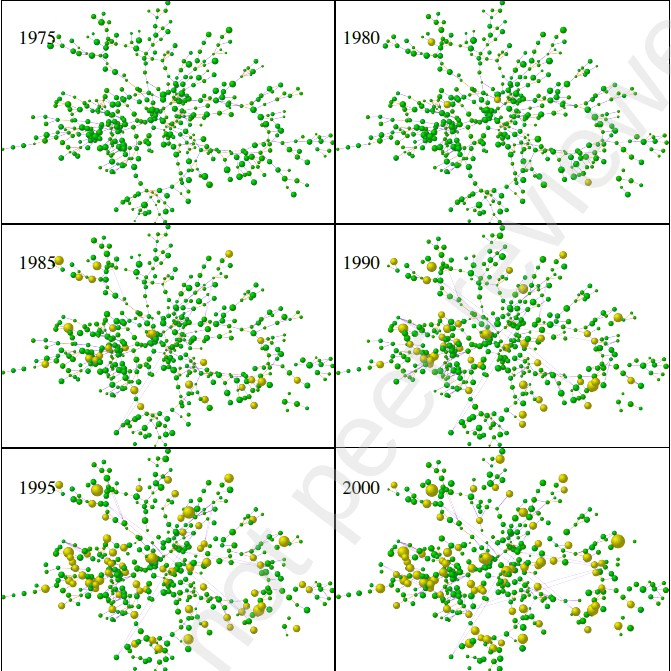
The thicker the dot, the higher the concentration of high BMI environments 😅.
- Each of us influences everyone. Behaviors are modeled by individuals.
- It is worth paying attention to who we spend time with.
- The whole process happens consciously and unconsciously.
- It is worth paying attention to what behaviors are normal in our environment.
All the best, besos. Sławomir Woźniak
Bibliography
[1] Albert Bandura, Social Learning Theory, 1977
If you need a website that builds trust and leads to a conversation, see the website offer .
Technology that works for your business
Ready to transform your business? Let's discuss your needs and find the best solution.